
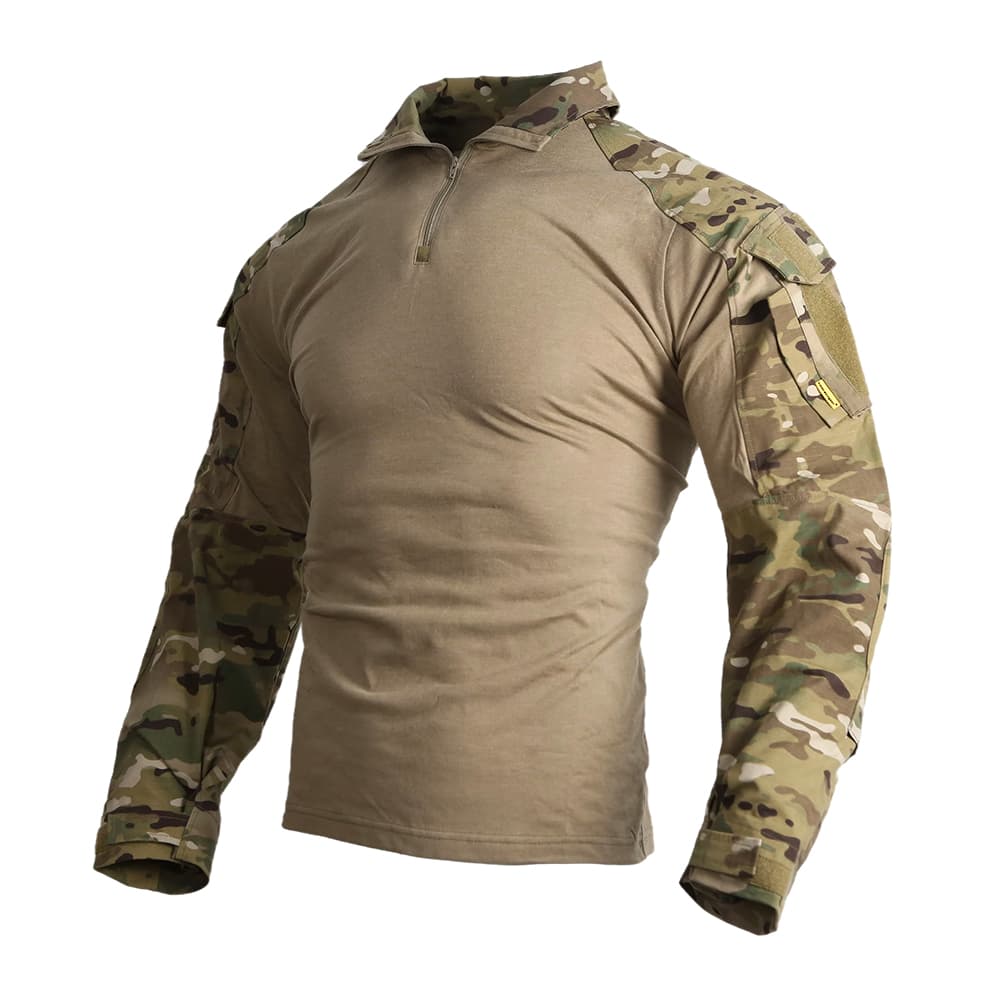
NC 50/50 vs TC 50/50 Tactical Uniform Fabric: How Buyers Should Choose
Introduction
NC 50/50 is a blend of approximately 50% nylon and 50% cotton; TC 50/50 is approximately 50% polyester and 50% cotton. Neither blend is automatically “better.” NC is often selected when abrasion performance and a field-uniform hand are priorities, while TC is often considered for value, color consistency, easy care, and faster-drying constructions. The correct choice depends on fabric weight, yarn, weave, finish, garment design, climate, test requirements, and budget—not fiber percentages alone.
For a distributor or uniform buyer, “NC or TC?” is therefore the beginning of the specification, not the end. Two fabrics with the same 50/50 label can perform differently because their yarn size, thread density, ripstop grid, finishing process, mass per unit area, and dyeing quality are different. This guide shows how to turn a broad blend preference into a sample and testing plan that a manufacturer can reliably quote.
At-a-glance comparison
| Decision factor | NC 50/50 (nylon/cotton) | TC 50/50 (polyester/cotton) | Buyer action |
|---|---|---|---|
| Typical sourcing position | Performance-oriented uniform fabric | Value and easy-care uniform fabric | Compare equivalent weights and constructions |
| Abrasion potential | Nylon can support strong abrasion performance | Polyester can also be durable; construction matters | Test the actual fabric, not the fiber name |
| Moisture behavior | Cotton absorbs moisture; nylon contribution varies by construction | Cotton absorbs moisture; polyester itself is low-absorbency | Compare drying and air permeability on finished fabric |
| Hand and field feel | Often associated with traditional tactical NYCO ripstop | Can feel crisper or smoother depending on finish | Approve a physical swatch and garment sample |
| Dimensional stability | Must be checked after laundering | Often selected for easy-care stability, but still test | Agree wash method and tolerance |
| Color and printing | Process must be matched to both fibers | Process must be matched to both fibers | Approve lab dip/strike-off and shade tolerance |
| Cost | Can carry a higher material cost in comparable constructions | Often more cost-efficient | Compare total specification, not blend alone |
| Hot-weather suitability | Possible in lightweight, breathable construction | Also possible in lightweight, breathable construction | Evaluate weight, airflow, drying, cut, and layers |
These are sourcing tendencies, not guaranteed performance claims. A heavy NC fabric can feel hotter than a light TC fabric. A well-engineered TC fabric can outperform a poorly controlled NC fabric in a buyer’s chosen tests. The comparison must use fabrics intended for the same product application.
What do NC, NYCO, TC, and poly-cotton mean?
In tactical apparel sourcing, NC or NYCO generally refers to a nylon-and-cotton blend. TC usually refers to a polyester-and-cotton blend. The order of letters is not a complete legal fiber declaration, and naming conventions can vary by market. The quotation, label artwork, and test report should state the generic fiber names and percentages.
For products sold in the United States, the Federal Trade Commission explains that most textile products require labels listing fiber content, country of origin, and the identity of the manufacturer or another responsible business. Buyers should confirm requirements for every destination market with their own compliance adviser rather than assuming one label works globally.
The blend ratio also needs tolerance and verification. “50/50” may be a commercial description, but a buyer requiring an exact declared composition should state the allowed tolerance and test method. Do not approve a fabric solely from an email description.
Why fiber content alone cannot predict performance
Yarn and fabric construction
Fiber is only one layer of the material system. Yarn count, filament or staple form, twist, weave, thread density, ripstop geometry, and finishing all affect strength, weight, hand, snag behavior, breathability, and appearance. A ripstop grid can help localize some tears, but grid size and yarn design still matter.
Ask the supplier to state:
- fiber composition;
- weave or knit construction;
- finished fabric weight in g/m² or oz/yd²;
- usable width;
- color or camouflage reference;
- finish, coating, or treatment;
- expected shrinkage under the agreed care method;
- applicable physical and colorfastness test values.
Fabric weight and thickness
Fabric mass influences coverage, drape, perceived heat, drying time, and durability, but it should not be used as a shortcut for quality. ASTM D3776/D3776M provides methods for mass per unit area. When comparing materials, test conditioned samples and state whether the weight is greige, dyed, printed, or fully finished.
A lighter fabric can improve mobility and reduce retained heat, but may require design changes at high-wear zones. A heavier fabric may resist rough use better yet become less comfortable in hot, humid conditions. Reinforcing knees, elbows, seat, pocket edges, or cuff areas can be more efficient than increasing the weight of the entire garment.
Finishes and coatings
Water-repellent, soil-release, anti-wicking, softening, resin, anti-microbial, or infrared-related treatments can alter hand, air permeability, color, care, and cost. Do not request a finish only by marketing name. Define the intended outcome, test method, performance target, durability after laundering, and any restricted-substance requirements.
If a performance claim is important, verify it on the finished production construction. A finish tested on a laboratory swatch may change after printing, cutting, sewing, or repeated laundering.
NC 50/50: where it can fit
NC blends are widely recognized in field and tactical uniform categories. Buyers often shortlist them for abrasion-oriented applications, authentic field-uniform positioning, and compatibility with established ripstop constructions. The U.S. Army has used nylon/cotton fabrics in combat uniform programs, but government-issued specifications should not be treated as proof that any commercial “NYCO” fabric meets a military requirement.
Potential reasons to evaluate NC include:
- repeated contact with rough surfaces;
- demand for a traditional woven tactical-uniform hand;
- an existing customer specification written around NYCO;
- a performance program with defined tear, tensile, seam, or abrasion criteria;
- brand positioning where the material story is already understood by buyers.
Potential constraints include material cost, sourcing availability, shade management, and the need to coordinate dyeing or printing across two fiber types. These are not universal disadvantages. Ask the mill and garment factory to confirm the actual supply route and lead time for the selected color and finish.
TC 50/50: where it can fit
TC blends are common in workwear, uniforms, outdoor clothing, and price-sensitive tactical ranges. They can be appropriate where easy care, repeatable commercial colors, quicker-drying constructions, and a controlled target cost are important.
Potential reasons to evaluate TC include:
- dealer or distributor programs with defined retail price architecture;
- uniforms that are frequently washed and need stable appearance;
- broad commercial color ranges;
- training, outdoor, security, or general-duty applications;
- projects where material availability and replenishment are key.
The phrase “poly-cotton” does not guarantee comfort, durability, or shrinkage performance. A dense, heavy TC can be unsuitable for a hot-weather requirement; a light construction may need reinforcement or a different seam design. Test the finished fabric and wear sample against the use case.
Which tactical uniform fabric is better for hot weather?
For hot weather, compare the whole garment system. The U.S. Army’s Improved Hot Weather Combat Uniform program reduced weight and also removed pockets, layers, and hook-and-loop in selected areas. That example illustrates an important design principle: thermal comfort is not determined by fiber composition alone.
Evaluate at least five factors:
- Finished fabric weight. Lower mass can reduce the material carried and may reduce drying load.
- Air permeability. ASTM D737 is one recognized method for measuring airflow through textile fabrics.
- Moisture behavior and drying. Absorbency, wicking, moisture management, and drying time are separate properties. AATCC lists methods for these different behaviors; choose the metric that matches the requirement.
- Garment architecture. Ventilation zones, pocket layers, reinforcements, torso panels, cuff design, and fit change heat and moisture management.
- Durability trade-off. A light construction may need reinforced high-wear areas or a more frequent replacement plan.
Do not write “for hot weather” in an RFQ without describing temperature range, humidity, activity level, layering, wash conditions, and expected service life. A wearer standing at a checkpoint has a different requirement from someone moving continuously with a pack.
Mid-article CTA — Ask for Fabric Options
Tell us the climate, product type, target fabric weight, color, expected order quantity, and required tests. We can review whether NC, TC, or another construction should enter the sample comparison. Send Your Requirements
Durability: what buyers should actually test
“Durable” should be translated into failure modes. For a tactical shirt or pant, the buyer might consider:
- fabric breaking strength;
- tear strength;
- abrasion or pilling resistance;
- seam strength or seam slippage;
- bartack and reinforcement performance;
- colorfastness to laundering, rubbing, perspiration, or light;
- dimensional change and skew after laundering;
- zipper, snap, hook-and-loop, and elastic function;
- wear trials at knees, elbows, seat, cuffs, and pocket openings.
ASTM D5034 covers grab breaking strength for many fabrics, and ASTM D1683 covers failure in sewn seams of woven apparel fabrics. AATCC TM135 addresses dimensional changes of fabrics after home laundering. These methods define how to test; they do not define the pass value for your product. Put the method, number of cycles, conditioning, specimen direction, and acceptance threshold into the purchase specification.
For a shipment inspection, lab tests alone are not enough. Inspect fabric identity and shade, garment measurements, workmanship, function, labeling, size ratio, and packing against the approved sample and documents.
Comfort and mobility: use a wear trial, not a hand-feel debate
Fabric hand can influence first impressions, but tactical apparel must be assessed while moving. Build a wear-trial protocol around the product application. For pants, include squatting, kneeling, stepping, climbing, seated movement, belt interaction, and access to cargo pockets. For combat shirts, check arm reach, torso length, collar comfort, cuff adjustment, sleeve pocket access, and movement under a vest or pack.
Use several wearers across the intended size range. Record garment size, wearer measurements, base layers, equipment, conditions, activity duration, and observed issues. Separate fit problems from fabric problems. Tight patterning can make a flexible fabric feel restrictive; excessive layers can make a breathable fabric feel hot.
Color, camouflage, and shade control
Fiber blends may require multi-stage or specially controlled dyeing and printing. The buyer should provide a physical color standard, approved lab dip or print strike-off, lighting conditions, and a tolerance or visual approval method. Digital screens are not reliable color standards.
For camouflage, approve scale, repeat, orientation, color set, and print hand. Confirm whether panels need matching or directional cutting. Decide how shade bands will be controlled within a garment, size set, carton, and reorder. If infrared reflectance or a government pattern is required, state the exact specification and authorization; do not assume a visual match proves performance or permission.
Laundering, shrinkage, and long-term appearance
Agree the care method before pattern approval. AATCC TM135 provides standard procedures for measuring dimensional change of fabrics after home laundering; AATCC TM150 addresses garments. The chosen wash temperature, cycle, drying method, and number of cycles affect the result.
Measure both fabric and completed garments where risk justifies it. A fabric may pass shrinkage criteria while a garment twists or puckers because of seam construction, fused components, mixed materials, or skew. Check pocket flaps, plackets, cuffs, waistbands, reinforcement panels, hook-and-loop, labels, and printed graphics after laundering.
Cost and MOQ: what changes the commercial result
Do not request one price for “NC 50/50 tactical uniform.” Cost can change with:
- finished fabric weight and width;
- stock color versus custom dye or camouflage print;
- order quantity by color;
- branded or controlled-origin materials;
- finish and testing package;
- garment complexity and reinforcement;
- size range and size ratio;
- packaging and labeling;
- inspection and destination requirements.
MOQ is also a supply-chain result. The fabric mill, dye lot, print run, trim supplier, label process, and garment line can each have a different minimum. Ask the factory to separate garment MOQ from material MOQ and explain how leftover material, repeat orders, or stock fabric are handled.
A practical fabric approval workflow
Step 1: define the use case
Document wearer, environment, activity, equipment interfaces, wash method, expected lifespan, target market, and price level.
Step 2: shortlist comparable fabrics
Request NC and TC options in comparable weights and constructions. Label each swatch with code, composition, construction, weight, finish, color, width, and source date.
Step 3: run development tests
Select tests based on failure risk. Use the same methods and conditioning for every candidate. Avoid comparing a supplier’s internal value with a third-party result produced under a different method.
Step 4: make identical garment samples
Where possible, use the same pattern and construction so differences are easier to interpret. Record any sewing adjustments required by each fabric.
Step 5: complete fit and wear review
Use a scorecard for mobility, thermal comfort, drying perception, noise, hand, pocket access, appearance, and damage. Record context rather than relying on memory.
Step 6: approve the specification and reference sample
Freeze the fabric code, BOM, test requirements, care label, measurements, workmanship, color standard, and approved sample. Require written approval for substitutions.
RFQ template for tactical uniform fabric
Include the following in your inquiry:
- Product: combat shirt / field shirt / tactical pants / uniform set
- End user and application: distributor retail / security / outdoor training / tender
- Climate and activity: temperature, humidity, movement, layering
- Preferred blend: NC 50/50 / TC 50/50 / open to recommendation
- Construction: ripstop / plain / twill / supplier proposal
- Target finished weight: ___ g/m² with agreed tolerance
- Color or camouflage reference: ___
- Finish or treatment: ___ with required test/durability
- Physical tests and pass criteria: ___
- Wash method and shrinkage requirement: ___
- Sizes, color ratio, and quantity: ___
- Branding, labels, packaging, and destination: ___
- Sample and required delivery dates: ___
This level of detail allows suppliers to propose comparable materials and explain trade-offs instead of guessing.
FAQ
Is NC 50/50 always more durable than TC 50/50?
No. Nylon has strong abrasion potential, but finished performance depends on yarn, weave, weight, finish, and quality control. Compare actual candidate fabrics using agreed tests and wear trials.
Is TC 50/50 always better for hot weather?
No. Hot-weather performance depends on fabric weight, airflow, moisture behavior, garment layers, ventilation, fit, and activity. Both NC and TC can be engineered in lighter constructions. Evaluate the finished garment system.
What GSM is best for tactical uniforms?
There is no universal best weight. The correct range depends on climate, durability target, opacity, garment design, and reinforcement strategy. Request several comparable swatches and test them before finalizing a number.
Does ripstop fabric prevent all tearing?
No. Ripstop construction can help restrict the propagation of some tears, but it does not make fabric tear-proof. Fiber, yarn, grid design, base construction, weight, wear, and seam placement all affect failure.
Can a supplier substitute another NC or TC fabric?
Only with written buyer approval. The replacement should be compared for composition, construction, weight, width, color, finish, test values, hand, shrinkage, availability, and cost. Approve a new swatch and sample when the change is material.
Which tests should I request?
Start with product risks and market requirements. Common considerations include mass, breaking or tear strength, seam performance, dimensional change, colorfastness, air permeability, moisture behavior, and finish performance. Agree the exact method and acceptance values before testing.
Conclusion
NC 50/50 and TC 50/50 are useful starting categories, but a professional buying decision must go deeper. Compare equivalent fabric weights and constructions, define the intended climate and activity, select tests based on real failure risks, and validate the choice in a completed garment.
The best fabric is the one that meets the documented customer requirements with acceptable comfort, durability, repeatability, availability, and landed cost. A physical swatch, controlled sample, and written test plan are more valuable than a broad claim that one fiber blend is always superior.
CTA: build a fabric and sample brief
Developing a tactical shirt, pants, or uniform program? Send your target market, climate, quantity, color, preferred weight, application, and test requirements. Emersongear can use those inputs to prepare a material discussion and sampling path without treating unconfirmed assumptions as specifications.
Ask for Product Catalog · Send Your Requirements